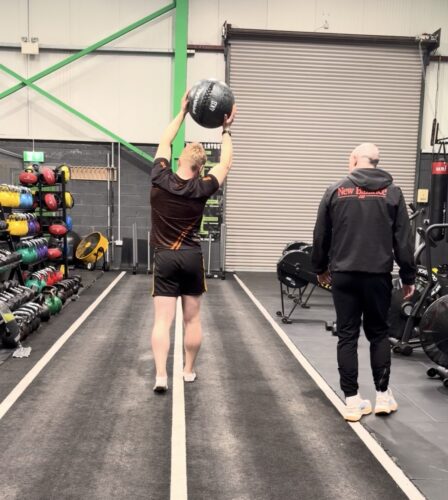
Why Steroid Injections Didn’t Fix This Hurler’s Back Pain
Liam works at the gym I train in. I spoke to him over a year ago about his low back
We’ve carved out a bit of a niche for ourselves in recent years at Petey Performance.
We have now worked with 50+ athletes recovering from ACL-surgery and returning to team-sports, primarily gaelic games.
And we’ve become pretty good at getting athletes back playing at a level above where they were pre-injury.
This is something that doesn’t happen for all athletes.
With the literature stating that only 50% of all athletes that suffer ACL-injuries return to sport at the same level as where they were pre-injury.
We’re happy to find ourselves on the right side of that 50% with our athletes.
Our systems and frameworks have become clearer and better defined through the years.
And this is why we get better results than most with ACL clients.
And thus our results speak for themselves.
But the other reason we get better results than other rehab teams, is that we have got pretty darn good at identifying common areas of issue with our ACL clients.
Given that they make up 20% of our client base, we have picked up patterns of behaviour where many go wrong during their rehab.
And once you start to spot these patterns, you get much better at nipping them in the bud early on.
Thus our athletes often return to play earlier than others and as I’ve outlined above, in much better condition than other rehabbers as well.
This ability to get our athletes back on the field in better physical condition than before is exactly what keeps them on the field upon their return.
Their risk of re-injury is lower as a result of the improvement in their overall performance.
And if we can manage load appropriately over the course of their return to team training, then their return to match-play becomes much more seamless.
They return more confident than ever before in the capability of their own body.
And that is something that has been shown to have a direct impact on athletes success in their RTP.
The athlete who trusts their knee, believes in the rehab process, and isn’t afraid to move is significantly more likely to return to sport than the athlete that returns with fear of re-injury and movement.
So, if you’re an athlete currently going through the ACL-rehab process, or if you’re a practitioner working with these clients, I’ve put together my 5 most common areas of neglect below for you.
These areas are often under-addressed and athletes suffer unnecessarily as a result.
If you can address these issues and also focus on improving consistency over the course of the rehab, I believe you’ll be in a much better position to return to play whenever that time comes for you.
In the early stages post-surgery, the ACL-graft is healing and you’ll be experiencing quite a high level of inflammation and swelling in and around the joint.
And for sure it’s important to get this swelling down and achieve the outcome of a “quiet knee.”
But that quiet knee only can be achieved if.
And all of the above outcomes only will occur after completing the required amount of active work.
Sure, passive recovery is important, but it can only be effective if you actually progressively load the knee and surrounding musculature to the necessary limits.
You need to load it to achieve the desired adaptation.
And granted that loading will be minimal in the early stages.
But frequent and progressive loading will beat sitting on your arse and doing nothing 10x out of 10.
This should not be idle time.
Take ownership of the process.
Do what you can to get moving.
Focus on doing what you CAN do vs what you CAN’T.
And you’ll get ahead of 90% of people if you do just that.
Consistency beats intensity time and time again.
Don’t wait for motivation to come.
Action comes before emotion.
So act now rather than later and your future self will thank you for doing so 9 months down the line.
Despite the fact that the injury has occurred at the knee…
It should not take up 100% of your time and energy.
If you want to ultimately get back to sport, then you need to be able to tolerate movements in multiple different directions.
And when you move in those directions and with those patterns of movement, your knee isn’t the only thing that experiences the load.
Your body must act as an integrated system to generate movement.
Multiple muscles and joints will act together to co-ordinate that movement.
So oftentimes when we observe athletes that have undergone ACL-surgery, we often say that, “they just didn’t move the same when they came back”.
If we want to avoid this happening, then we can’t allow the body to lose its ability to move freely and forcefully through all of the joints of the lower body.
Movement is a use it or lose it quality.
So if we take 6-12 months off from loading movements at the foot & ankle, we generally won’t be as adept at those actions upon our return.
If we don’t focus on integrating movement of the entire lower body together for quite some time, we can’t be surprised when we don’t feel co-ordinated when we return to doing them.
So, we combat this by again focusing on what we CAN do over what we CAN’T.
If the knee is still recovering from the surgery and not that adept at tolerating loading just yet, then we can still load the posterior chain, the lateral hip and the foot and ankle pretty aggressively.
The number 1 thing I see with athletes that don’t work with us for their entire process is, they often have quite a poor ability to be reactive and stable through the ankle once they return to jumping and running.
Get it in early and then you won’t lose it.
The knee is priority one for sure.
But it can’t be everything!
It may shock you to hear that when athletes come to work with us halfway through their process, we often do a lot more by subtraction than via addition.
Often when I have a look at their program, they’re executing a heap of different squat and knee extension variations, but they still have quite a poor level of strength in their quad.
How is this possible?
Well when they’re executing all of those different variations, they only execute a small amount of sets of each.
And they leave something in the tank on each of them because they know that they have more loading coming.
I often would prefer if they would simply focus on 1-2 exercises and get really damn good at them, by pushing to intensity in their sets and completing greater volume than they were previously.
We give their quads little option but to get stronger in those movements.
And if they reach a level where that movement becomes easy, then we have 2 options.
We either…
Load it more aggressively.
Or…
We move onto something else.
Don’t try to fill all buckets at once.
Focus on improving in something you’re not really good at.
And if you do that, it is very likely that everything else gets a lot easier as a result.
Despite what I’ve covered so far, the early-middle stages of rehab are actually the stages that are often completed to a much higher standard than the end stage.
The end-stage is often unspecific, under-coached, poorly progressed and ineffective.
A few tempo runs, some closed change of direction drills and a couple of sprints are put down on paper and the athlete is told to go away and see how they get on.
In my opinion, this is simply not good enough.
Unless we improve the athletes’ ceiling pre-RTP, then they’re going to be likely to be right back on the sidelines with one injury or another in the coming years.
So, we start exposing the athletes to positions relevant to linear speed early on in our rehab process.
And once they improve their tolerance to accessing those positions, we progressively increase the intensity, velocity and variability in their drills and exercises to allow them to get more adept at accessing them at speed.
We expose them to running mechanics drills earlier than most, but we spend more time on these drills than most as well.
We don’t settle for going through the motions in them.
We pick drill variations that are specific to the client and their needs in order to improve their sprint efficiency and we push them to intensity in them to get the most out of them.
And after we’ve done that, we don’t waste any more time on the drills…
We get them to sprint.
We start with short distances to develop their acceleration technique and tolerance.
And then we progress to max velocity in order to push that ceiling upwards as well.
Often we expose them to more max speed volume than they’ve covered in the past.
And that is how we have confidence that they will return to sport with both greater effectiveness and efficiency in their linear speed than before.
I’ve already mentioned that many athletes are under-coached over the course of their end-stage rehab and RTP.
And they’re also almost always prescribed some closed change of direction drills to do by themselves once they get back on the pitch.
And although we would certainly prefer for them to complete some progression in their change of direction drills to more intense and chaotic work.
We also would prefer for them to be actively coached in their closed change of direction work as well.
Otherwise we’re focusing too much on WHAT they’re doing, rather than HOW they’re doing it.
And HOW you execute an action is even more important than WHAT you do during ACL rehab & RTP.
We need to help the athlete to move more efficiently if we’re going to have high confidence that they won’t suffer the same injury upon their return.
And the only way we can do that is by coaching them.
Otherwise we’re simply hoping for the best.
Hoping the athlete moves more efficiently by themselves.
With no direction at all.
Like they’re shooting a bullet at a target in the dark.
Our job is to coach.
So that’s what we should be doing.
We should understand what efficient movement looks like.
We should be able to identify potential inefficiencies in our athletes’ movement.
And we should be able to coach them to improve upon them.
We do this both through our exercise selection and our cueing.
Not by one or the other.
And once the athlete has improved their COD efficiency, that’s when it’s time to start progressing through a continuum of more specific and more chaotic work relevant to the game they’re going back to.
That’s how we give them the evidence that they’re ready to return.
That’s how we improve their confidence in their ability to tolerate sporting demands.
That’s how we achieve better results than most in ACL-rehab & RTP.
And I suggest that’s how you do it too.
If you’re currently on your own ACL rehab journey and feel a little lost or unconfident in your ability to return to play successfully, then feel free to book a call with me below.
Happy to offer some help in any way I can.
Liam works at the gym I train in. I spoke to him over a year ago about his low back
Hardware. Software. Your computer needs both to function. If you want to improve its performance, then you know you’ll need
The best athletes don’t just ask “how?”. They ask “why?” Many average athletes are happy to be led along and

Here to help you achieve your health and performance goals.
At Petey Performance, I’ll assist you every step of the way. What’s stopping you?
Take ownership today.
© 2021 All Rights Reserved
Subscribe to Petey Performance and get updates on new posts plus more exlusive content.