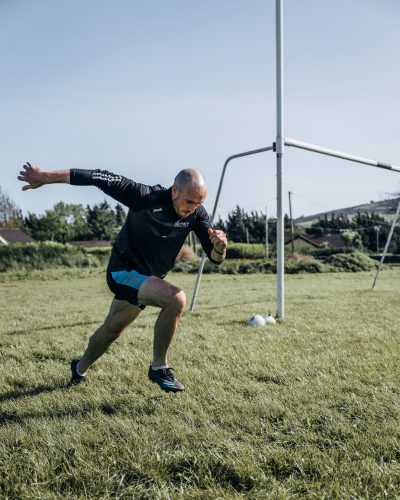
The 5 Qualities Every Fast Athlete Possesses
Every single athlete is looking for the X factor. The thing that separates the elite from the average. The thing

Most athletes overestimate what they can achieve in 3 months, but severely underestimate what’s possible in 12.
We work with athletes regularly over the course of a 3-month period.
In fact it’s our minimum sign-up term for online coaching.
However, the reason that we’ve set it as our minimum sign-up duration, is because it’s typically the minimum amount of time necessary to start to see some decent results from your new training program.
It keeps our athletes in the game long enough to start to see a return on the time investment they’ve put into their training.
It’s also long enough for them to build some better habits around their performance and integrate them fully into their lifestyle.
However, that doesn’t mean that at the end of a 12-week cycle they’re going to be a completely different athlete than before.
Sure, we can increase their speed, increase their strength, increase their range of motion and begin to reduce their injury risk over the course of 3 months.
But if they’ve had longstanding issues in relation to recurring injuries and gaps in their performance, then it’s unlikely that we’ll be able to move them from a subaverage performer to an elite performer in a mere 12 weeks.
However, what we can do is make a start on that journey.
We can get them from subaverage to average, and maybe even surpass that level.
However, becoming elite in anything requires a longer time horizon, that makes use of compounding returns to multiply our gains.
We all have seen it happen.
We’ve seen a player that was at the back of the pack, steadily improve over time and in a couple of years become a mainstay in the team.
However, it is much rarer to see a player that is hanging on, suddenly explode and become the best player on the field overnight.
And whenever this does happen, it’s usually with those athletes in the early stages of their career, who make use of low external stress, great recoverability, newbie training gains and a huge potential to succeed in a new environment.
Once you’ve been playing for a number of years, moving in the same way, with the same deficits and the same inefficient movement patterns, it can be a little harder to change the route your body takes to generate movement.
But that doesn’t mean it’s impossible.
It simply means that it requires consistency and a whole lot of patience.
If we break it down and think about it in cycles…
Our training calendar in team-sports is typically broken up into 4 distinct phases.
Through each of these phases we will have different goals, different rhythms, different training frequencies, different training volumes and different priorities.
If we set aside 1 of these blocks for development, then sure we can make some decent gains.
We push hard for a number of weeks before backing off slightly to realise the supercompensation effect of overreaching in our training.
We push the body to adapt and then allow it to recover in order to allow our new physical performance to shine through without the presence of fatigue.
However, if we do this a number of times in a season, imagine where we could be vs where we are now?
Realistically, our greatest opportunities to push hard are going to be in both off-season and pre-season periods.
During the season, we will still be able to make incremental gains by keeping ourselves on the field and available for training and match-play.
However, during the competitive, business-end of the season, our priorities will change and our biggest goal will be performing as best as we can in each coming game.
Our opportunity to push will be reduced to a couple of isolated sessions midweek.
But realistically if we can retain the physical level that we enter this period with, then that will be a huge win.
It will mean that we’re starting from a higher level at the beginning of the coming off-season.
And then we get the opportunity to repeat the process again.
If we do this over the course of a 12 month macrocycle, with 3x intensive mesocycles in the calendar (and 1 maintenance phase), then don’t be surprised if you feel like a completely different athlete at the beginning of the new season.
So, this is why our training process doesn’t necessarily make a clear distinction between rehab & return to training and training to maximise performance in competition.
We’re doing both simultaneously and good rehab and good training aren’t at all different.
Good training is just good training.
And good training gets the most out of the athlete in the long-term.
It requires you to stay in the game long enough to go through multiple cycles of supercompensation.
Multiple cycles of supercompensation afford you the opportunity to reinvent yourself as an athlete.
This opportunity is not given after making some short term changes to your lifestyle and habits.
It requires you to become a different person first and then the results are likely to follow.
And all good things take time.
Change is one of those things.
Stay in the game.
Long enough to win.

Every single athlete is looking for the X factor. The thing that separates the elite from the average. The thing

It’s a form of self-sabotage. Really, it is. Some athletes half-ass it because they want to protect their ego. You

This is not going to be easy. It is going to take a lot of hard work and effort. But