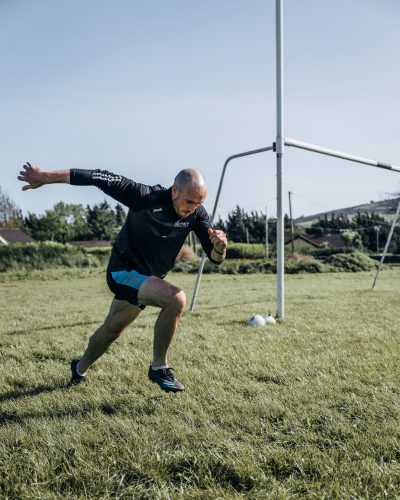
The 5 Qualities Every Fast Athlete Possesses
Every single athlete is looking for the X factor. The thing that separates the elite from the average. The thing

Sport specific S&C gets a bad rap.
But that’s because of the connotations that the statement brings to mind.
It evokes a picture of athletes trying to replicate what happens in their sport within the gym.
And that’s not what the gym is for.
Bands coming from all different directions, an athlete balancing on a Bosu ball, replicating a technical action from their sport, all whilst trying to imagine they’re in the field of competition.
Soccer, golf, rugby, surfing, swimming.
You name the sport.
It’s been bastardised in some way, shape or form by some charlatan S&C coach.
So in some ways sport specific S&C deserves the bad rap that it gets.
But although I think that the above form of training is dogshit, I don’t believe that the phrase “sport specific” deserves what it gets.
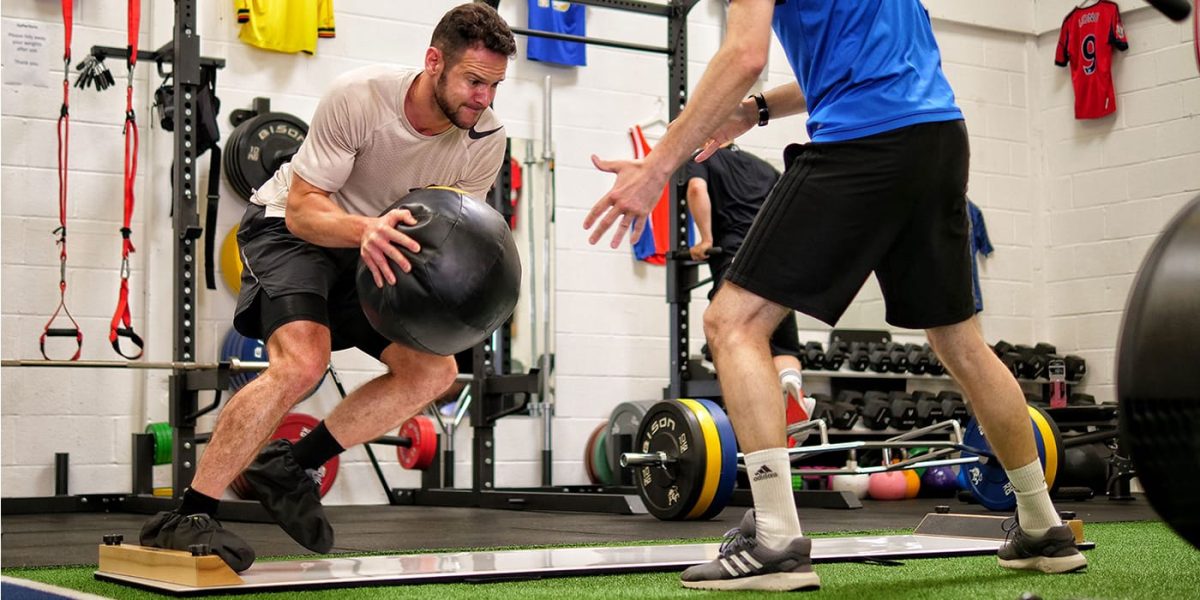
You see, sport specific, in my opinion, shouldn’t mean trying to replicate sporting actions in the gym.
It should mean training the specific physical qualities that allow you to thrive in your sport as an athlete.
So, if we break down the sport of gaelic football, or any team-sport for that matter, we need to be able to
So, in my opinion, sport specific S&C should simply mean, training an athlete to execute the above actions more efficiently and more effectively so that they can perform in their sport at a higher level.
We should be breaking down the movement demands and components of the athlete’s sport and then training them to execute those actions at a higher level than they were previously.
And in my opinion, those coaches that can identify the gaps in an athletes
Can usually better achieve success with that athlete in preparing them to play their sport at a better level.
Coaches that are more successful than their peers, are simply those that are better at
So, there are two pieces to that.
Firstly, if you have an idea of what an athlete should be working on, but you can’t confidently put your finger on it, then you’re already starting from a position of weakness.
The better you get at breaking down movement, identifying what an athlete’s bias is, what they’re good at and what they’re not so good at, the more specific you can get with your solution to their current problem.
It’s important to note that you can never have 100% confidence that you will get this right 100% of the time.
Humans are complex organisms and the body is a complex system.
You can get better at understanding how it works and what underpins efficient movement, but I’m afraid none of us are God.
You can’t be completely right 100% of the time.
However, by getting more reps in with more athletes and learning from others in different areas of the industry, we can get better at seeing what the issue is most likely to be.
We develop an elite coaching eye.
And then our problem-solving skills can get better from there.
So, with identification of the issue already improved using coaching eye, data and experience, the next step is developing your ability to implement solutions to the problem.
Being well read and familiar with the principles of S&C is imperative.
But being up to date with what is being done in different sports within the industry is equally as important.
Different sports have different sporting cultures.
These sports often get siloed into one form of training simply because it is the way that things have always been done.
However, if a coach, team or athlete gets drawn into doing this, then nothing new or better is ever likely to come out of the process.
The same process begets the same results as before.
If you want to achieve something different, then you need to do something differently.
However, rather than coming up with a completely new training modality or system, it is much easier to simply reflect on what is being done successfully in other sports, understand why it is working and then ask yourself how that system could be used in your own current context.
This is why it is important to be both well-versed on what has been done in the past, but also on the cutting edge of what is being done at the present.
From there, the only way that you can figure out if any of the newer age training methods actually work, is by trialling them yourself.
The best coaches understand the principles behind why something works.
They understand which aspects of the training must stay present and which can change.
From there, they can easily use their knowledge and understanding of training principles, in order to create a solution to whatever movement problem they’re faced with.
That means that they don’t think in terms of
Common problem = Specific Exercise as a Solution
But they ask themselves, “what does this athlete need to do at this time?”
“How do I get the athlete to do that repeatedly?”
And from there they choose the appropriate solution for this specific athlete, at this specific time.
This process of exercise selection and execution is dynamic.
The same exercise may not work for the same problem for different athletes.
Or for the same athlete for that matter.
Based on where they are at in terms of their performance, their RTP timeline or their season, different exercises may be more or less appropriate.
So, the best coaches simply get better and better at getting specific.
Not always “sport specific.”
But definitely “athlete specific.”
And that’s how the athlete begins to get closer to achieving their full potential.
Identify the problem
Implement the solution.
Simple.
Specific Training should be simple.
Every single athlete is looking for the X factor. The thing that separates the elite from the average. The thing
It’s a form of self-sabotage. Really, it is. Some athletes half-ass it because they want to protect their ego. You
This is not going to be easy. It is going to take a lot of hard work and effort. But