The 5 Qualities Every Fast Athlete Possesses
Every single athlete is looking for the X factor. The thing that separates the elite from the average. The thing

This is a hard nut to crack.
Most athletes come to work with us in pain.
They want their pain to go away.
That’s often why they decide to work with us in the first place.
However, often early on in their rehab, we need to challenge their beliefs and help them to understand that pain is actually ok.
Actually, it’s almost expected as part of the rehab process.
You see, pain is still not very well understood.
However, we do understand that pain often comes along with a less than desired level of physical performance.
If we are to get an athlete out of pain, then improvements in physical performance are our goal.
If they’re performing at a higher level than before and their body can tolerate higher intensity demands and higher volume of work, then their level of pain is likely to reduce with time.
Their overall risk of injury is also likely to reduce as well.
So, in order to stress their body to adapt and achieve an improved level of physical function, we must challenge it.
We must place stress on the body in order to illicit adaptation.
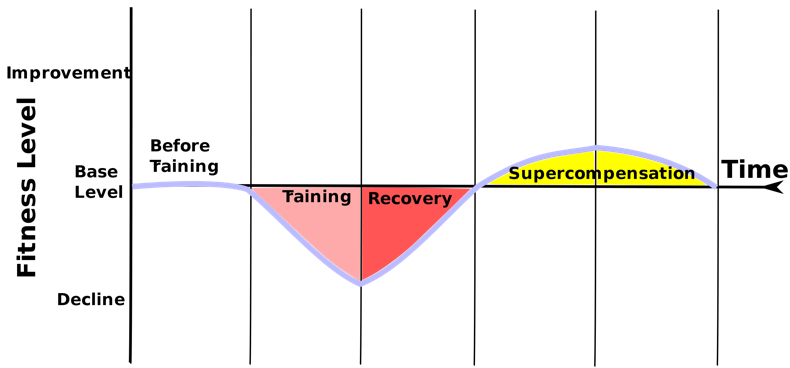
And when we place stress on the body, we must then give it time to recover in order to achieve the supercompensation effect (see below).
If the body is already in a state of inflammation, as is common when pain is present, then placing added stress on it will be likely to lead to more inflammation.
More inflammation may actually lead to pain.
However, we are using the tradeoff of stressing the body just enough that it recovers to a higher level than it was at before.
Tolerating the same level of stress that it once did is now easier.
And as a result, the likelihood of pain and injury at that previous level is likely to reduce.
If our goal was simply to allow pain to subside, then we would simply seek to protect over stress.
We would drop all stress that we put the body or tissue through to zero.
And as a result pain would be more likely to go away.
However, we would be doing the athlete a disservice by doing so, as we wouldn’t be helping them to tolerate the demands of their sport in the long-term.
We haven’t improved physical function and tolerance for loading so when the athlete decides to go back to sport, the pain is extremely likely to come back.
And when it comes back, as result of the lack of loading and the detraining effect taking hold, the athlete may be even at a higher risk of injury and pain than before.
We haven’t improved the athlete’s physical performance. We may actually have done the opposite.
So, in high performance rehab & RTP, reducing pain is a goal, but it is a secondary goal.
The primary goal is improving the athlete and their tolerance to loading.
So, success can look different for different athletes at different stages of the process.
However, as you can expect, the golden goose doesn’t occur 100% of the time.
It may occur at different stages of the process and we’d love for it to happen towards the end of RTP, but we can’t be frustrated if it doesn’t occur straight away.
Rehab and training is not just about pain.
It’s about performance.
And performance can’t live in the presence of pain.
But the foundations for it can certainly be laid down in the presence of pain if that pain stays within an acceptable threshold.
So, don’t fear pain in rehab and RTP.
It’s likely to happen.
It is simply a signal from your body that something is awry.
It doesn’t mean that you need to stop altogether.
It simply means you may need to change tack slightly.
Be that loading, volume, intensity or modality.
Pain doesn’t mean we need to sit and wait.
It simply means we may need to get off the motorway and take a slip-road.
Don’t let pain derail you altogether.
Success looks different at different stages of the process.
Every single athlete is looking for the X factor. The thing that separates the elite from the average. The thing

It’s a form of self-sabotage. Really, it is. Some athletes half-ass it because they want to protect their ego. You
This is not going to be easy. It is going to take a lot of hard work and effort. But
