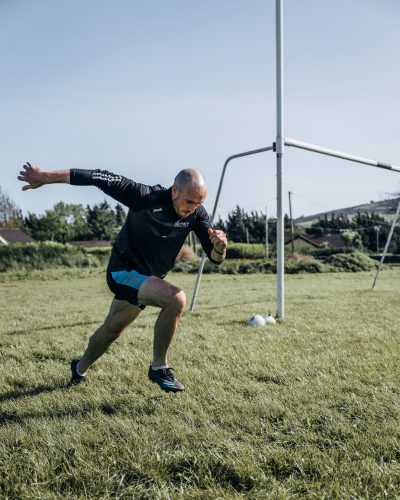
The 5 Qualities Every Fast Athlete Possesses
Every single athlete is looking for the X factor. The thing that separates the elite from the average. The thing
I work with athletes every single day who are attempting to return to sport after serious recurring injuries.
And although what we focus on for the most part is their body and their ability to move efficiently…
I also get incredible insights into how people think and how their beliefs and thought-patterns often repeatedly hold them back from success in sport and in life.
Because I have worked with 100s of athletes over the years, I’ve got better and better at spotting patterns of behaviour in the athletes that come through our doors.
And although we refer out for any sport psychology support necessary for each individual athlete, myself and our team of coaches often discuss in great detail what it is that we need to focus on with each individual athlete to achieve long-term change.
We discuss HOW we can best communicate with each athlete to achieve the best outcomes.
We focus on whether we should be 10x the positive reinforcement we are delivering to a particular client, or being a little sterner with another whilst pointing out their work-ons.
This is a huge part of coaching.
And it’s something that is often overlooked by many coaches and therapists.
Your athletes want you to be well read and up to date with the most recent research for sure.
But your job isn’t to simply read research and identify problems.
Your job is to identify potential problems and help the athlete to enact solutions.
And in sports performance there are very few overnight solutions.
All solutions to complex problems occur progressively over time.
Our thoughts become our emotions.
Our emotions influence our actions.
Our actions over time become our behaviours.
And our behaviours create our life.
So although it’s never an athlete’s fault that they have suffered injury, it is their responsibility to be part of the solution.
We help the athlete to identify and integrate that potential solution into their life.
We hold them accountable to practice those solutions consistently over time.
And those actions repeated consistently become their behaviours, which then can help them to achieve more success in their life.
That’s our responsibility as coaches.
That’s why our clients trust us.
And that’s why we take our job so seriously.
We do our best to repay that trust in us by helping our athletes to change.
So, identifying self-limiting beliefs and unhelpful thought-processes is extremely important in our field of work.
Here are a few of the common archetypes of thinking that I see holding athletes back on a day to day basis.
Believing that things are the way they are and you can’t change them is one way for things to stay the absolute same.
It’s comfortable.
It’s easier to blame your lack of perceived success as a result of external factors and luck than it is on your own habits.
It’s easy to put people in a box and put any of their success in any endeavour down to their natural abilities.
It’s a get out of jail free card for not trying to improve any of your abilities.
You are as fast as you’ll ever be.
Your teammate is faster than you because they were born that way.
You’re a good defender because it comes naturally to you not because you put effort into it.
Your teammate is a good attacker because it comes naturally to them not because they dedicate time to work on their skills.
You’re not a strong player because you never have been. It couldn’t possibly be down to the fact that you don’t dedicate enough time to actually working on that physical quality.
Your ankle range of motion is restricted because of an old injury there. It’s always going to be restricted and there’s nothing you can do about it.
Easy right?
Putting others in a box makes it really easy for you to stay in yours.
I’m not here to argue the nature vs nurture debate.
Sure, some people have a certain propensity to succeed in certain areas over others.
But you can certainly do more with what you’ve got than what you’re currently doing.
You might not be able to run the 100m in 10s.
But I bet you could get your max speed from 7.5 m/s ⮕ >8 m/s
From what we know now about epigenetics, how we behave and act can influence the expression of our genes.
You may not be fast now but maybe that’s simply because you’ve never worked consistently at it.
You may not be strong now but maybe that’s simply because you’ve never consistently pushed yourself to intensity in the gym.
You may not have the best ankle mobility in the world, but maybe it’s because you do f*** all to actually improve it.
It’s easy to stay in your box.
Comfortable even.
But if you continue to sit there. That’s where you’ll be likely to stay.]
Good things don’t come from comfort zones.
I see this all the time as well.
Athletes are ready to jump at the work in week 1 of their rehab & RTP.
But then they realise that there’s a lot of work to do.
And they realise that it all needs to be done consistently.
They give it their best for a few weeks.
But then they miss a session here and a session there.
And eventually weeks are going by with nothing being done at all.
Where they were making some improvement, now the opposite is happening.
They’re going backwards.
This is why we practice the principle of “Something is always better than nothing.”
We live in an imperfect world.
Things get in the way. Life happens.
And as a result you may miss a session here or there.
Your fuelling may not be perfect all of the time.
Your sleep is not always going to be 10/10.
But all we can control is what we do in the present moment.
If we live as best as we can in the grey, then success is going to be much more likely than if we strive always to be in the white.
There is no perfect program.
There are no perfect exercises.
There is no perfect adherence to the plan.
However, there are better and worse.
There is more or less.
We don’t strive for perfection because perfection is not possible.
We strive for better.
We strive for more-efficient.
We strive for more-consistent.
We strive for more-enjoyable.
We don’t classify exercises as good or bad.
We don’t classify exercises as good or bad.
We don’t classify athletes as good or bad.
We seek improvement over perfection.
And that is how you succeed in the long-term.
This is a major scourge in rehab & RTP.
Athletes come to work with us and from day dot we outline that we don’t work with timelines.
Life doesn’t work in timelines.
Success doesn’t occur in time-restrictions.
And putting time-restrictions on your goals is only likely to add unnecessary pressure.
“I must be ready to play by X date”
“I have to be playing the best football of my life this season”
“I’ve got to be achieving all that I want to achieve in the next X months”
I’m afraid life isn’t that simple.
Success occurs at different times for everyone.
Different bodies respond differently to training.
Different athletes reach their peak athletic performance at different stages of their career.
All that putting time-pressure on yourself is likely to do is to add more psychological stress to your system.
It’s likely to lead to more tension, more pressure and more stress.
That’s definitely not going to create the best environment possible for recovery and performance.
We never use words like “have to”, “must” or “need”.
We accept that we have work to do and do our best in each and every moment to be the best version of ourselves that we can be.
We try to practice this ourselves and help our athletes to do the same.
When we remove pressure from the equation, things get far easier.
And if things are easier we can move with more freedom, more creativity, more fluidity and more expression.
That is where elite performance lives.
If you are only open to trying things that you’ve tried before, how do you expect to achieve anything different to what you have achieved before?
If you only believe in one method of training, then you’re likely missing out on a lot of other potentially useful approaches that you could benefit from.
We choose to not be married to any forms of training.
We don’t rely on specific exercises over others.
We remain open to finding a solution for each and every client.
And that solution may be completely different on a client to client basis.
Sure, we will always try things that have worked before.
But if those methods aren’t working then we will always seek an alternative solution.
Doing the same thing again and again and expecting a different outcome is the definition of madness.
We do our best to be as open as possible with our systems and process.
And we ask our athletes to do the same.
Commit to action and give everything your 100% effort.
Only by believing that what you’re doing may help can you ever hope to get the most out of your training.
Belief is imperative.
Without that success is impossible.
This is probably the hardest one to speak about.
However, it’s something that I see regularly.
And something that I lived myself as a young athlete.
Asking “why me” is never useful.
What has happened is not your fault but it is your responsibility.
If you choose to play the pity card then don’t be surprised if you never actually get out of pain.
Sympathy is great, but it doesn’t actually help you out of your current situation.
The only thing that is likely to help you out of the hole that you’re in is action.
And you need to be the one to take action.
If you say that you’ve “tried everything”, then that doesn’t really leave any room for trying anything new.
If you constantly complain about the injury cycle repeating itself, then don’t be surprised if it repeats itself again.
Not much good can come from predicting the future based on your past experiences.
If you keep repeating the same mistakes, then for sure you should maybe start trying something different.
However, the only way that something different is going to work is if you can do your best to stay positive and focus on what may happen if all goes to plan.
Believe that the positive outcome is possible.
That is going to lead to more diligence in the work that you are going to do.
Don’t throw the baby out with the bathwater if you suffer a minor setback.
Setbacks are a part of the process.
They are simply information that you can use to continue to refine your approach.
No story or comeback is ever perfect.
No road back to performance is ever a straight one.
But remember to speak to yourself like the strong, capable person you are.
You’ve overcome a lot to get to this point in the process.
The only way to make this time different than the others is by putting one foot in front of the other.
You only truly fail when you stop trying.
So do your very best to keep going.
Success will come if you do just that.

Every single athlete is looking for the X factor. The thing that separates the elite from the average. The thing

It’s a form of self-sabotage. Really, it is. Some athletes half-ass it because they want to protect their ego. You

This is not going to be easy. It is going to take a lot of hard work and effort. But


Here to help you achieve your health and performance goals.
At Petey Performance, I’ll assist you every step of the way. What’s stopping you?
Take ownership today.
© 2021 All Rights Reserved
Subscribe to Petey Performance and get updates on new posts plus more exlusive content.